
Milltown Roots to an American War Grave on French Soil
Early Life and Emigration
John Naughton was born on 4 December 1888, to Martin Naughton and his wife, Honor (née Conroy of Drum) of Carrowreagh, Milltown. They were a farming family and he was their first-born. He was later joined by 3 brothers and 2 sisters. His surname and that of his siblings can be seen incorrectly, phonetically recorded as Nocten in some historical records.
Parents
His father, Martin, was son of John Naughton of Ahascragh Ballinasloe and Bridget Gannon of Carrownanagh Dunmore. His mother, Honor, was daughter of Michael Conroy of Drum, Milltown and Mary Grehan of Emeracly.
Siblings
Mary married Thomas Dullaghan, a guard from Co Louth. They lived in the towns where he was stationed. They retired to Ballindine, Co Mayo. They are laid to rest in Kilclooney cemetery Milltown.
Delia married William McCarthy a chauffeur from Mount Shannon. Co Clare. They lived and raised their family in New York. They are laid to rest with Delia’s uncle Thomas Naughton in Woodside cemetery, Queens, New York.
Patrick (Pake) married Delia McGrath of Clashaganny. They lived on the original farm in Carrowreagh. They are laid to rest in Kilclooney cemetery Milltown. John’s Grand Nephew (Grandson of Patrick Naughton) still resides on the homestead in Carrowreagh, Milltown.
Michael married Mary (Molly) Walsh of Belmount. They are laid to rest in Kilclooney cemetery Milltown. Martin lived out his final years with them in Ardnagall untill his death in 1938. John’s Grand Niece (Michael’s granddaughter) lives in Kilclooney.
Dennis married Sarah (Sis) Mannion of Clashaganny. They lived in Clashaganny. They are laid to rest in Kilgeverin cemetery.
According to Census information from 1901 and 1911, John could read and write and he spoke Irish and English in the home. He more than likely went to school in the Boys School in Milltown which was located on the North side of the village where the football pitch is now situated.
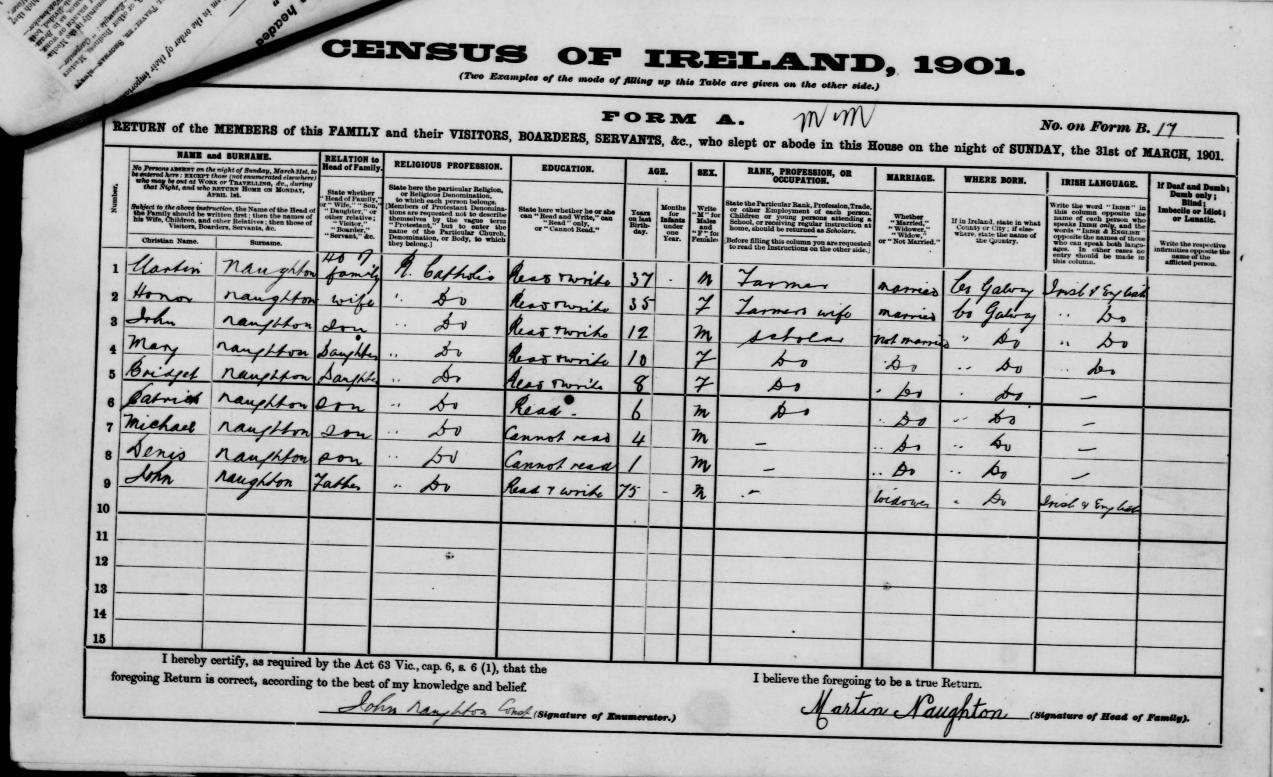
1901 Census
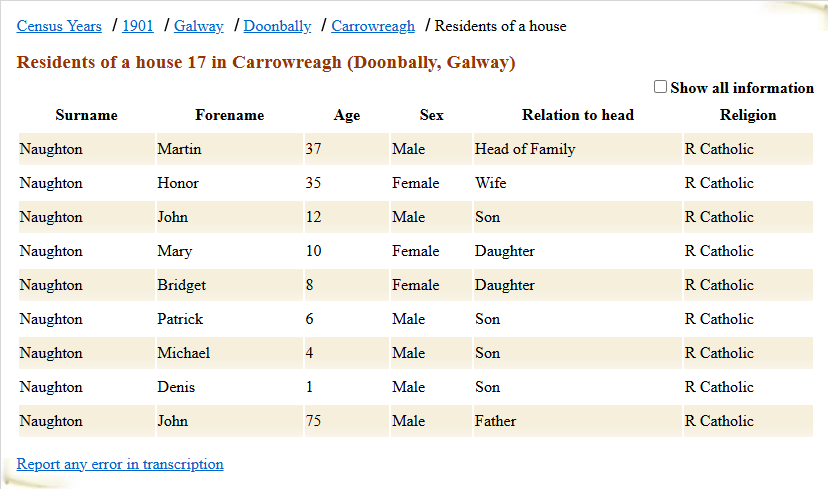
1901 Census
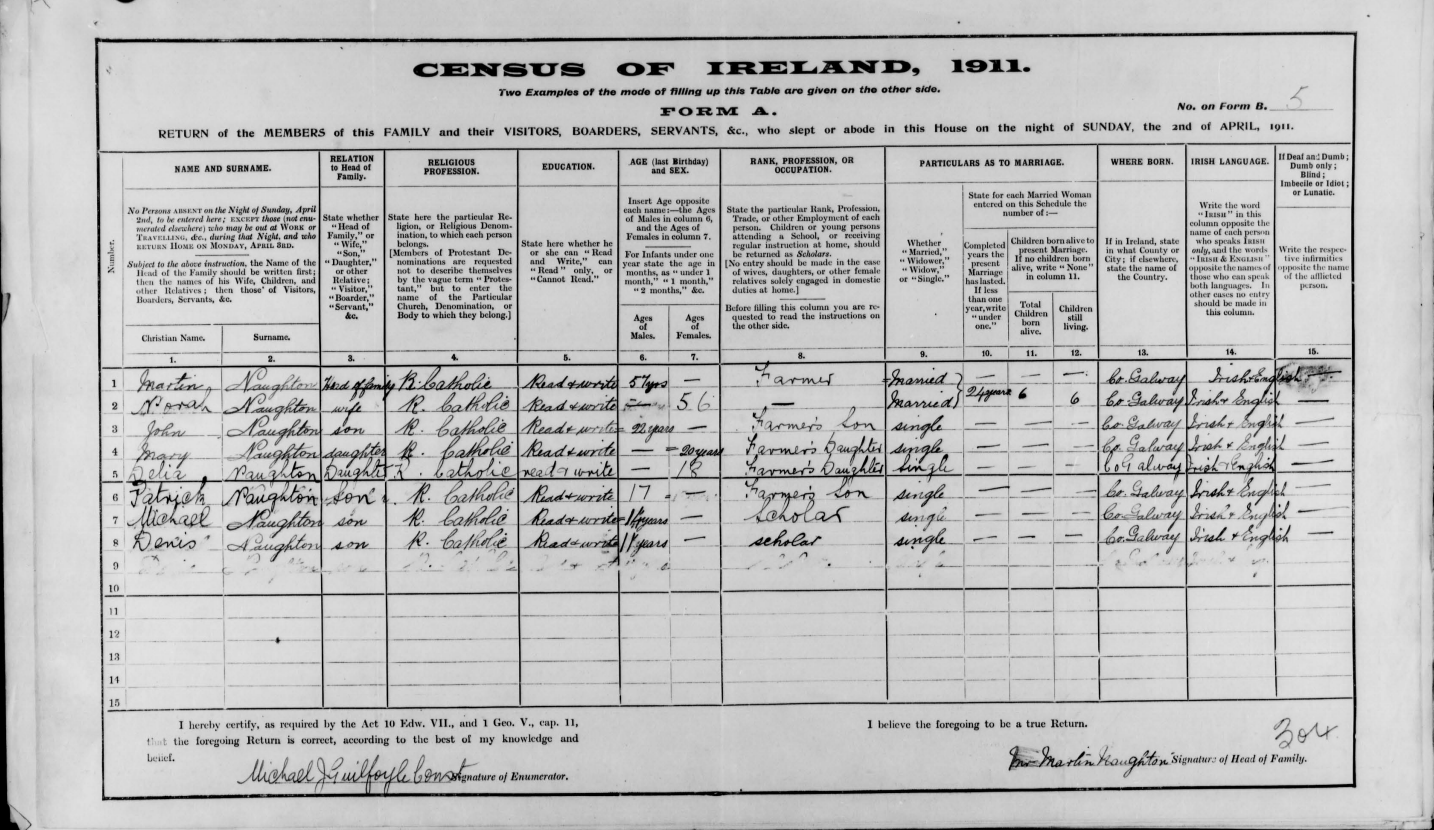
1911 Census
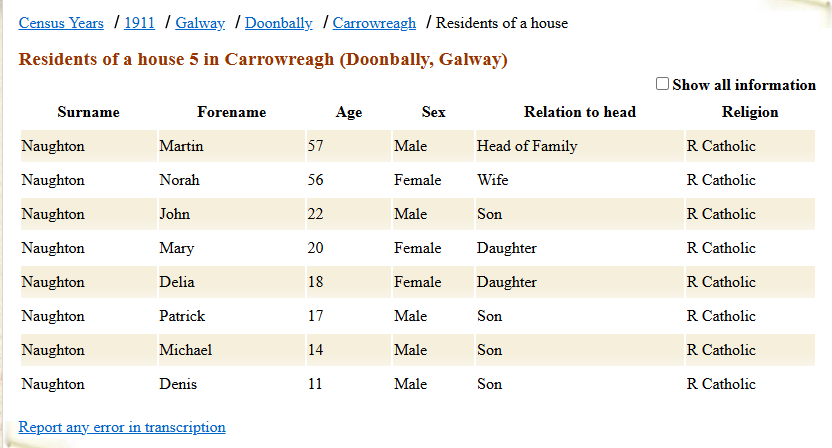
1911 Census
Aged 26 years, he emigrated from Liverpool aboard the SS Baltic, departing on 9 December 1914 and arriving in New York City after 10 days at sea on 19 December 1914.
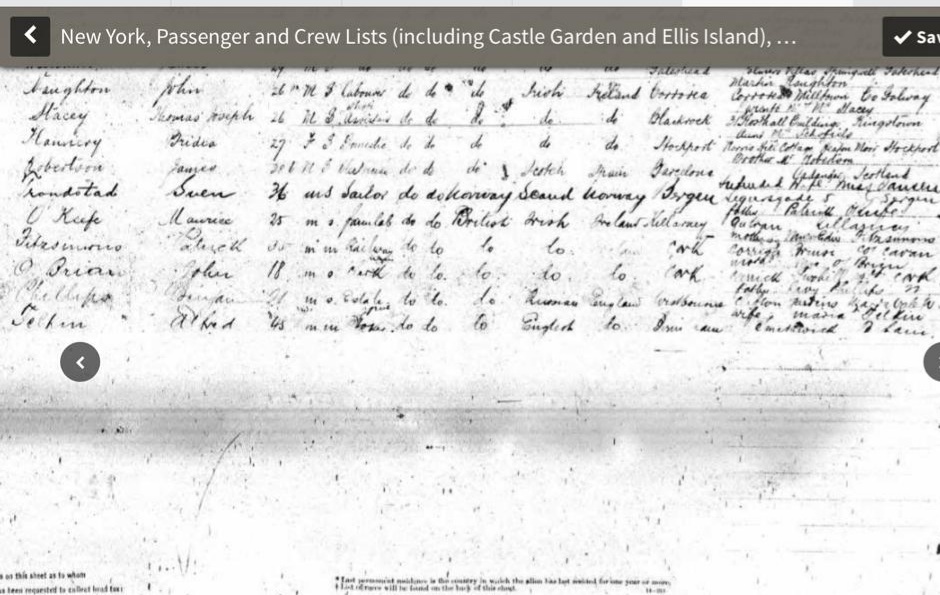
Passenger List for New York disembarkment
He initially lived at 201 E 61st Street, Manhattan, New York, in the boarding house of his Aunt, Mary Naughton, she never married. His uncle Thomas also resided in New York and was married to Mary Egan, they had no family. Johns’ younger sister Delia, who had emigrated in 1912, lived at the boarding house as well until she married William McCarthy in May 1917. John worked as a Utility man in the 3 years he lived in New York. He moved to 1249 Park Avenue, New York before he enlisted in the US Army.
Military Service – U.S. Army, World War I
John enlisted at the 69th Armory, New York City, on 28 June 1917, and was mustered into federal service on 24 July 1917 aged 28.
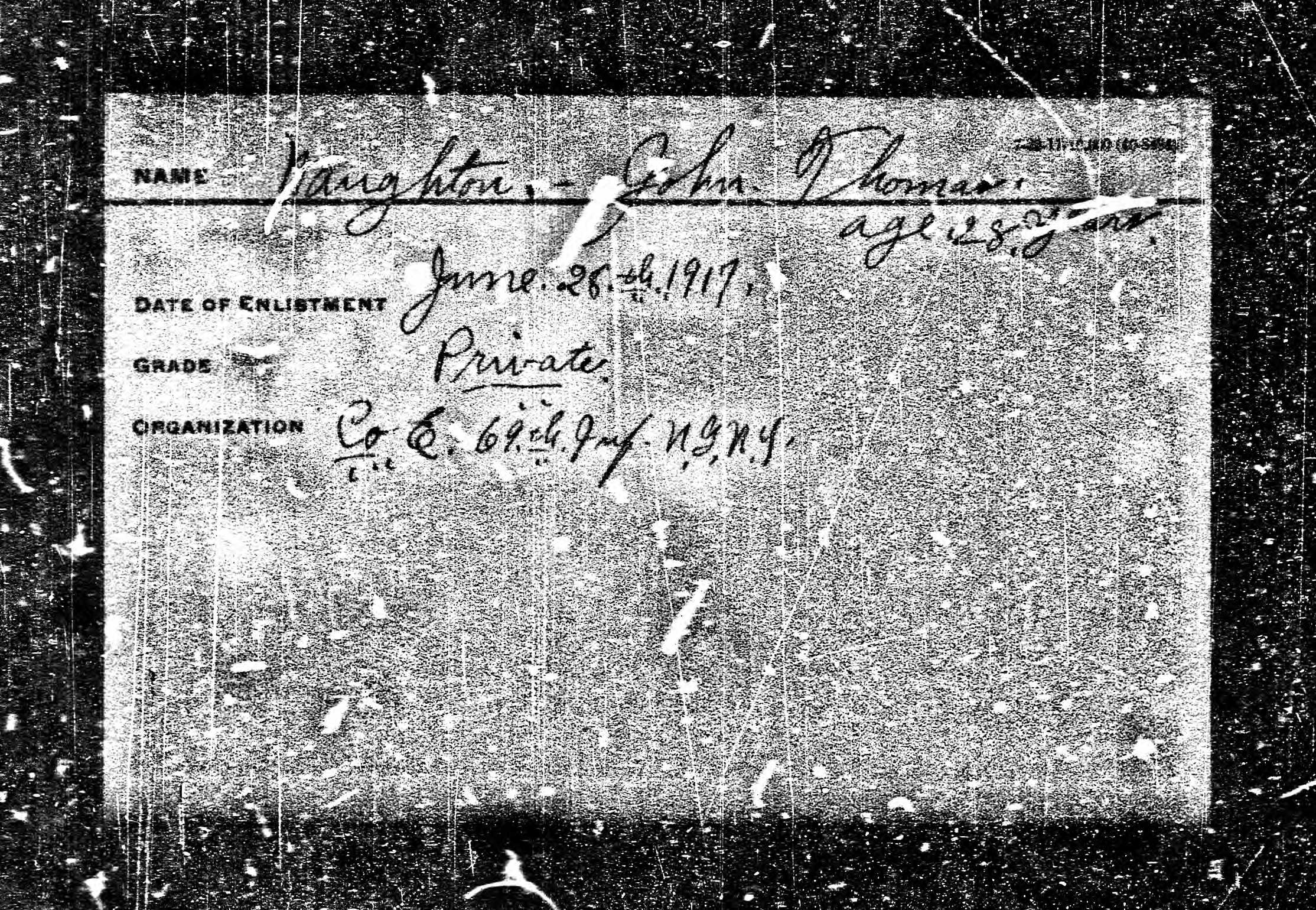
Enlistment Card
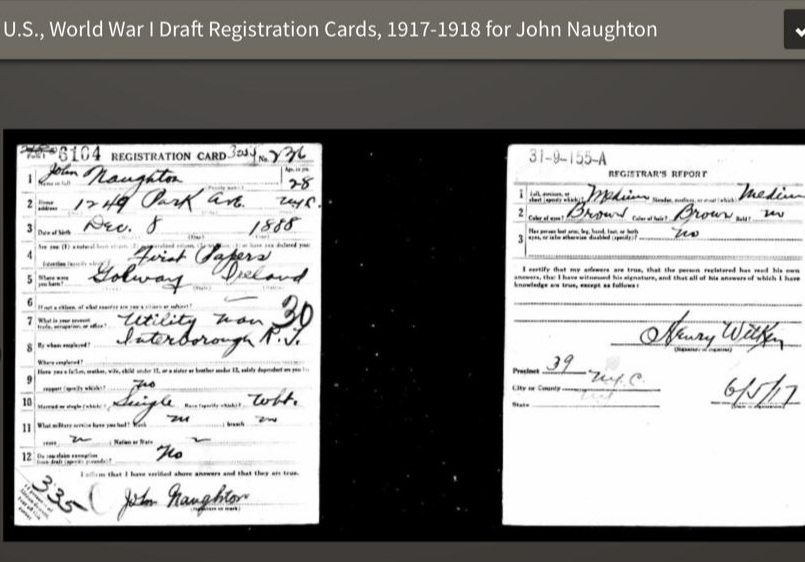
WW1 US Army Draft Registraion Card for JN
He was assigned Serial No. 90 189, and served as a Private in Company E. This was changed to the 165th Infantry Regiment, part of the famed 42nd “Rainbow” Division of the American Expeditionary Force. John served overseas in France from 29th Oct 1917. John added the middle name of “Thomas” to his full name to differentiate himself from other John Naughtons in the Army.
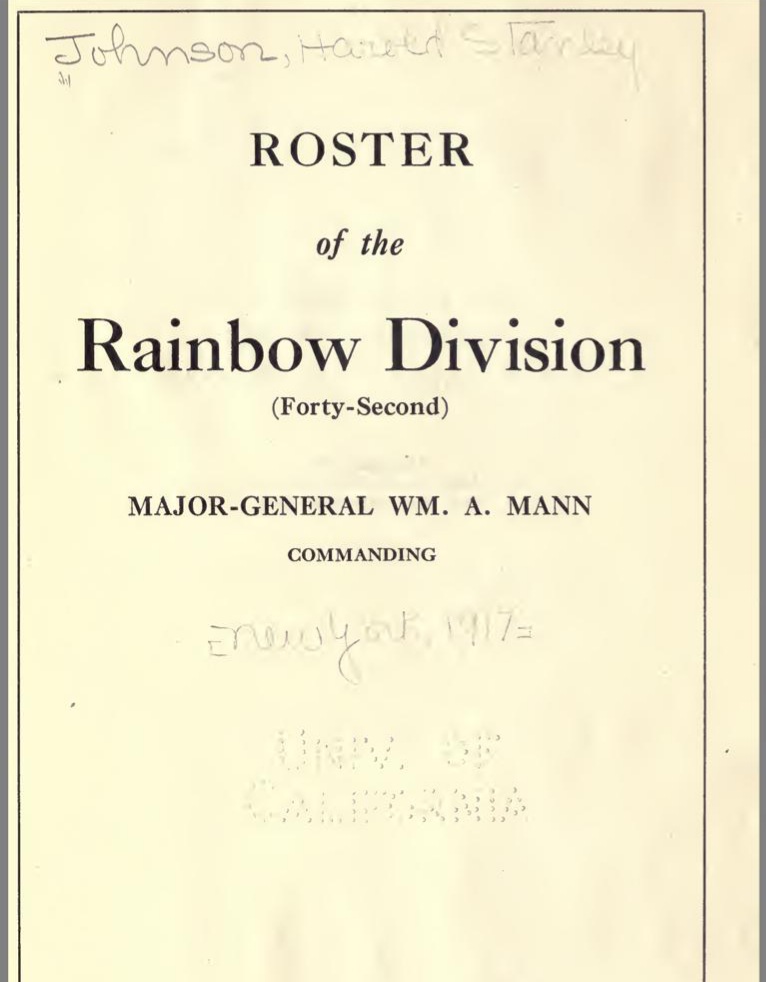
Rainbow Division Roster
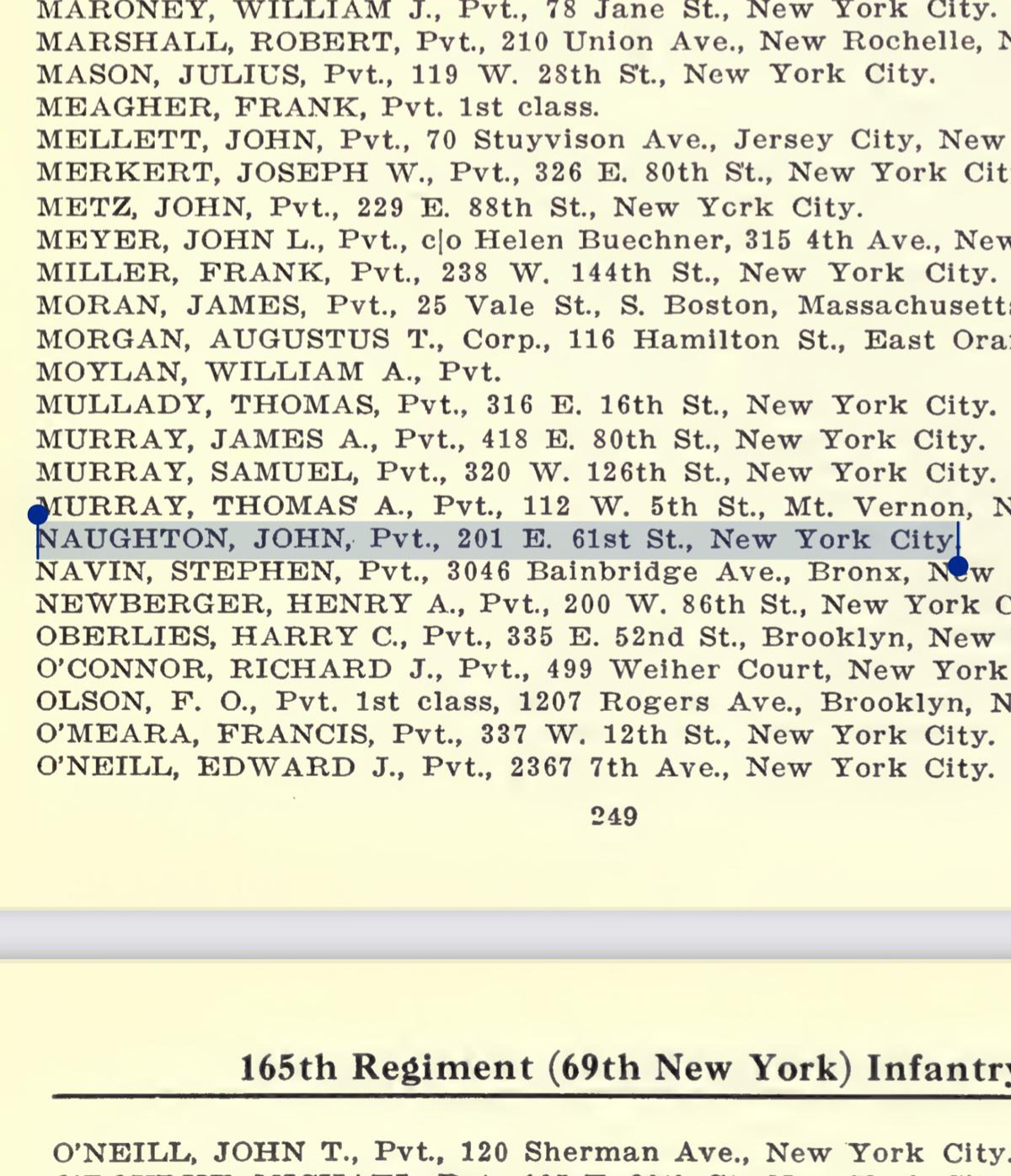
Rainbow Division Enlistment roll with JN address at his sister in NY
Historical Significance of the 165th and Rainbow Division
- The 165th Infantry—formerly Longshore’s legendary Fighting 69th Regiment—was federalized as part of the newly-formed 42nd Division in August 1917, drawing troops from across 26 states and D.C. The unit retained its Irish-American heritage and distinctive insignia 💚☘️org+1museum.dmna.ny.gov+3Wikipedia+3National Guard+3.
- The Rainbow Division was named by the infamous General Douglas MacArthur. During the unit’s organization in 1917, MacArthur, then a colonel and Chief of Staff, remarked that the division, composed of National Guard units from 26 states, stretched across the United States “like a rainbow” according to the New York Division of Military and Naval Affairs. This comment resonated with those present, leading to the adoption of the “Rainbow Division” nickname according to the New York Division of Military and Naval Affairs.
- The Rainbow Division was engaged in major operations at St. Mihiel and the brutal Meuse–Argonne Offensive, the latter being America’s largest battle of WWI. The 165th suffered heavy losses during October 1918, including battles at Landres‑et‑St. Georges and elsewhere in Argonne country Wikipedia+3National Guard+3DVIDS+3.
- The 165th Regiment, formerly the “Fighting 69th” of New York, saw 164 days of combat during WWI, recording over 2,500 casualties including nearly 900 deaths, earning 60 Distinguished Service Crosses and 3 Medals of Honor for its members museum.dmna.ny.gov+3museum.dmna.ny.gov+3Wikipedia+3.
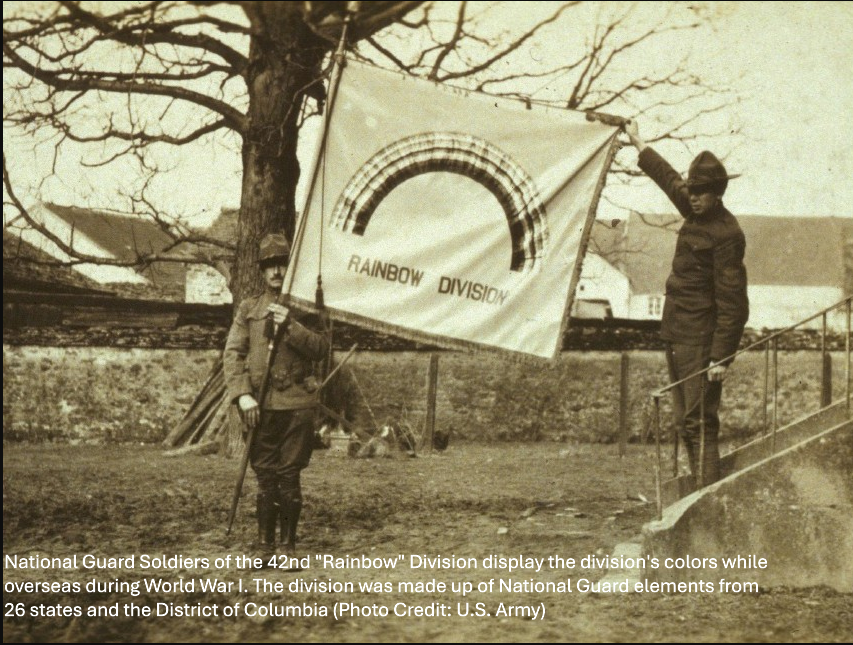
War Department. Army War College. Historical Section. World War I Branch. ca. 1918-ca. 1948 Rainbow Division Flag
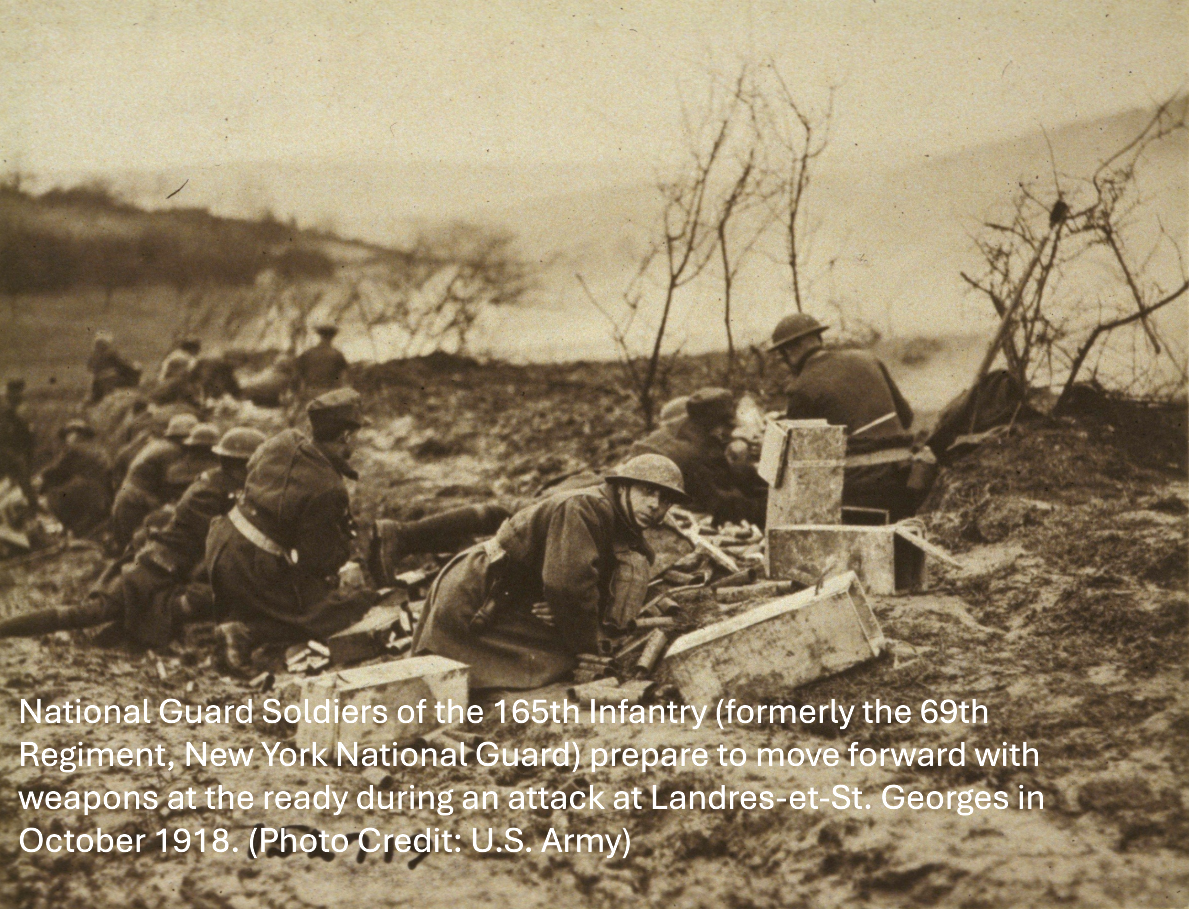
165th Infantry at Landres-et-St. Georges Oct 1918
- During the Meuse–Argonne Offensive, the division played a pivotal role in driving across open terrain under heavy enemy fire, helping bring the war to a close on the Western Front museum.dmna.ny.gov+4National Guard+4DVIDS+4.
- Father Francis P. Duffy was a prominent chaplain in the U.S. Army during World War I primarily in France, best known for his service with the Fighting 69th (later the 165th Infantry) of the 42nd (Rainbow) Division. He was highly regarded for his bravery and dedication to the soldiers under his care, often going to the front lines to provide comfort and support to the soldiers earning the nickname “Fighting Father Duffy”. He returned to his parish in New York after the war and published a memoir, “Father Duffy’s Story,” which became a bestseller. John Naughtons name is mentioned in this book. The book grew from a manuscript originally started by a close friend to Duffy, Joyce Kilmer who had converted to Catholicism and had joined the regiment. After Kilmer was killed in France, Duffy was encouraged to complete the work of chronicling the regiments involvement in WW1. A monument to Father Duffy was erected in Times Square in 1937, naming the area Duffy Square.
Wounds, Death, and Commemoration
Wounded in battle, John was transferred to a medical field hospital at the Château de Salvange (in the Meuse department) which was used as a U.S. Mobile Hospital during World War I, particularly during the Meuse–Argonne Offensive.
- Mobile Hospital No. 2 of the American Expeditionary Forces was established at Château de Salvange, near Rarecourt in Meuse, starting around September 24, 1918, and remained in operation through November 5, 1918
Tragically, Private John Thomas Naughton succumbed to his fatal wounds and died on 22 October 1918, less than 2 months before his 30th birthday.
The war officially ended on 11 November 1918 and John died just 20 days before World War 1 ended.
For a brief moment, his sister Delia in New York and his family back home in Ireland would have shared in the joy and relief felt around the world at the ending of the war and the return of their son and brother. However, that joy was shattered just days later, on 16 November 1918, when Delia received the devastating formal news of John’s death by Military Telegram.
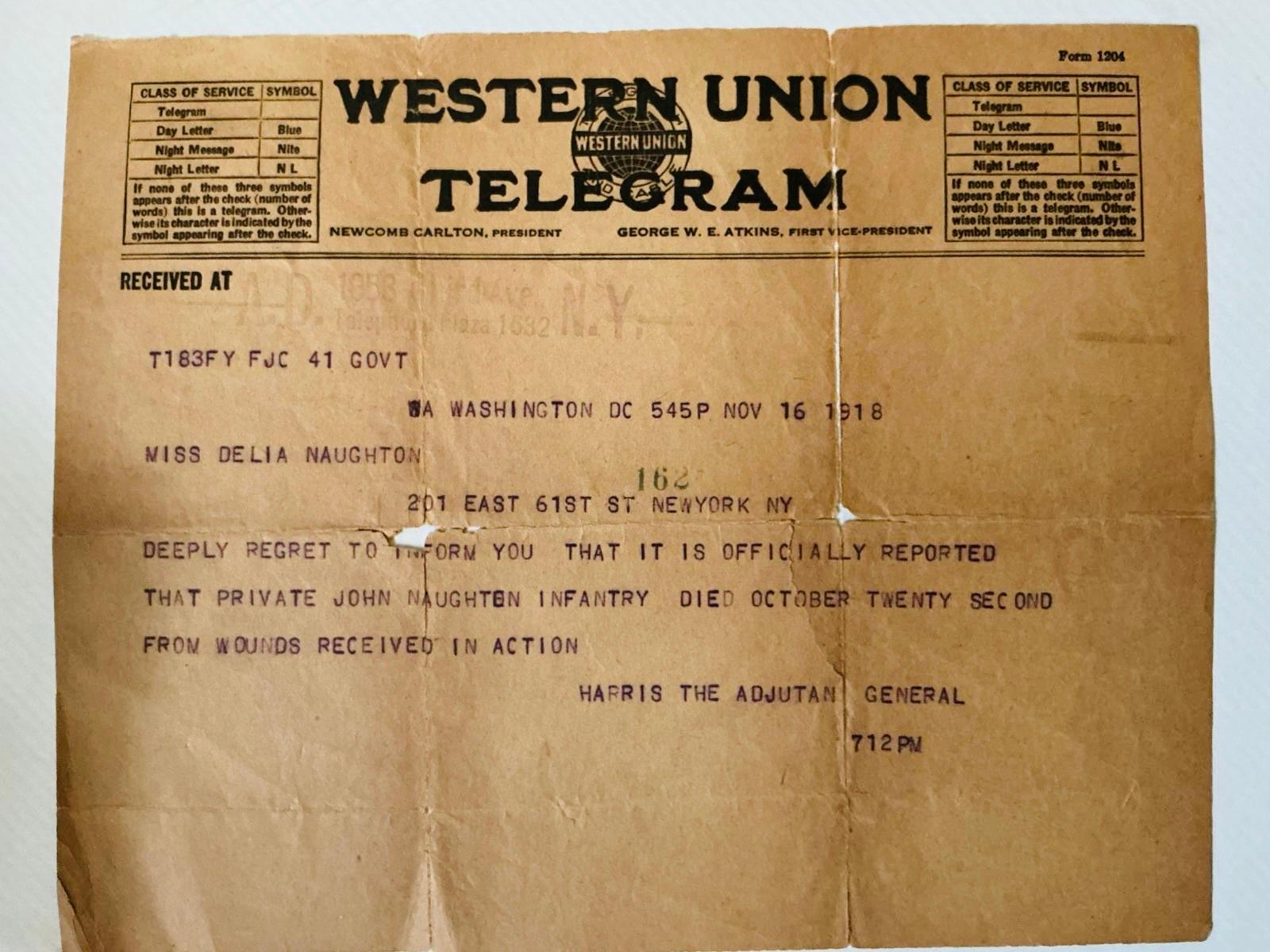
Telegram – photo supplied by Maura Rudyk granddaughter of Delia Naughton
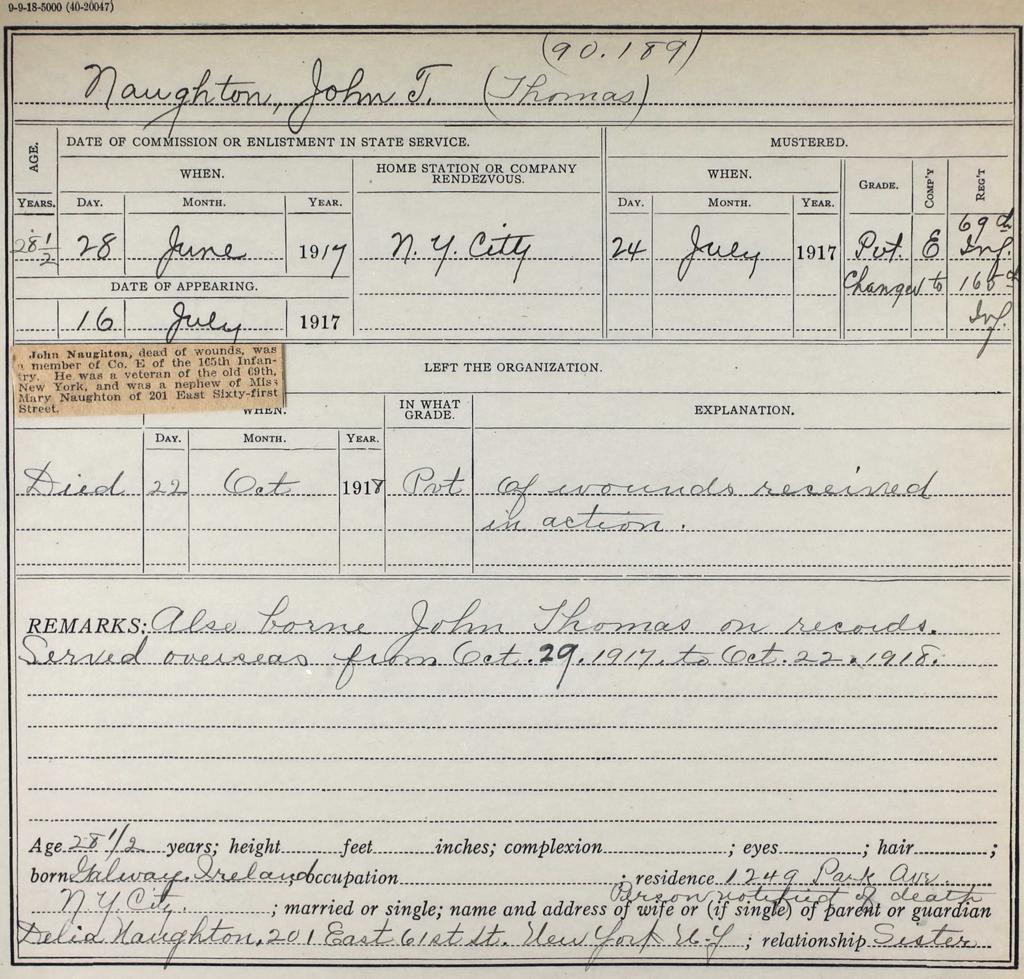
Service Card from US Army
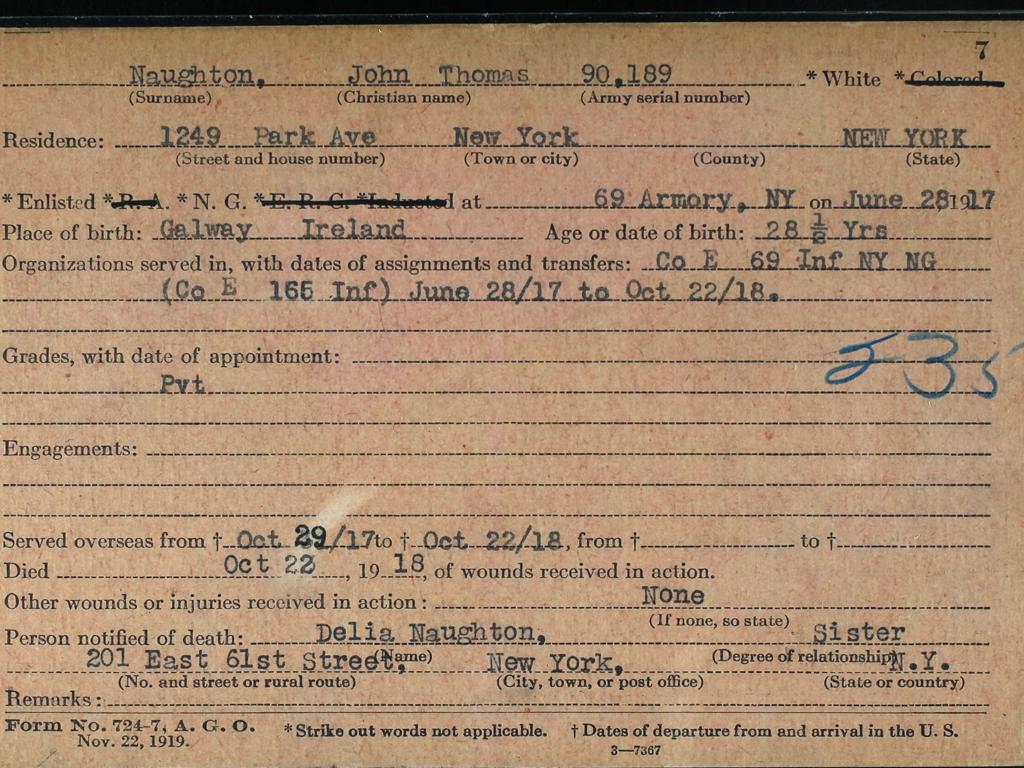
Statement of Service Card _ Form No. 724
After moving his remains from a temporary cemetery on the grounds of Château de Salvange, Johns final resting place is in the Meuse-Argonne American Cemetery in Romagne-sous-Montfaucon, France, in Plot B, Row 41, Grave 24.
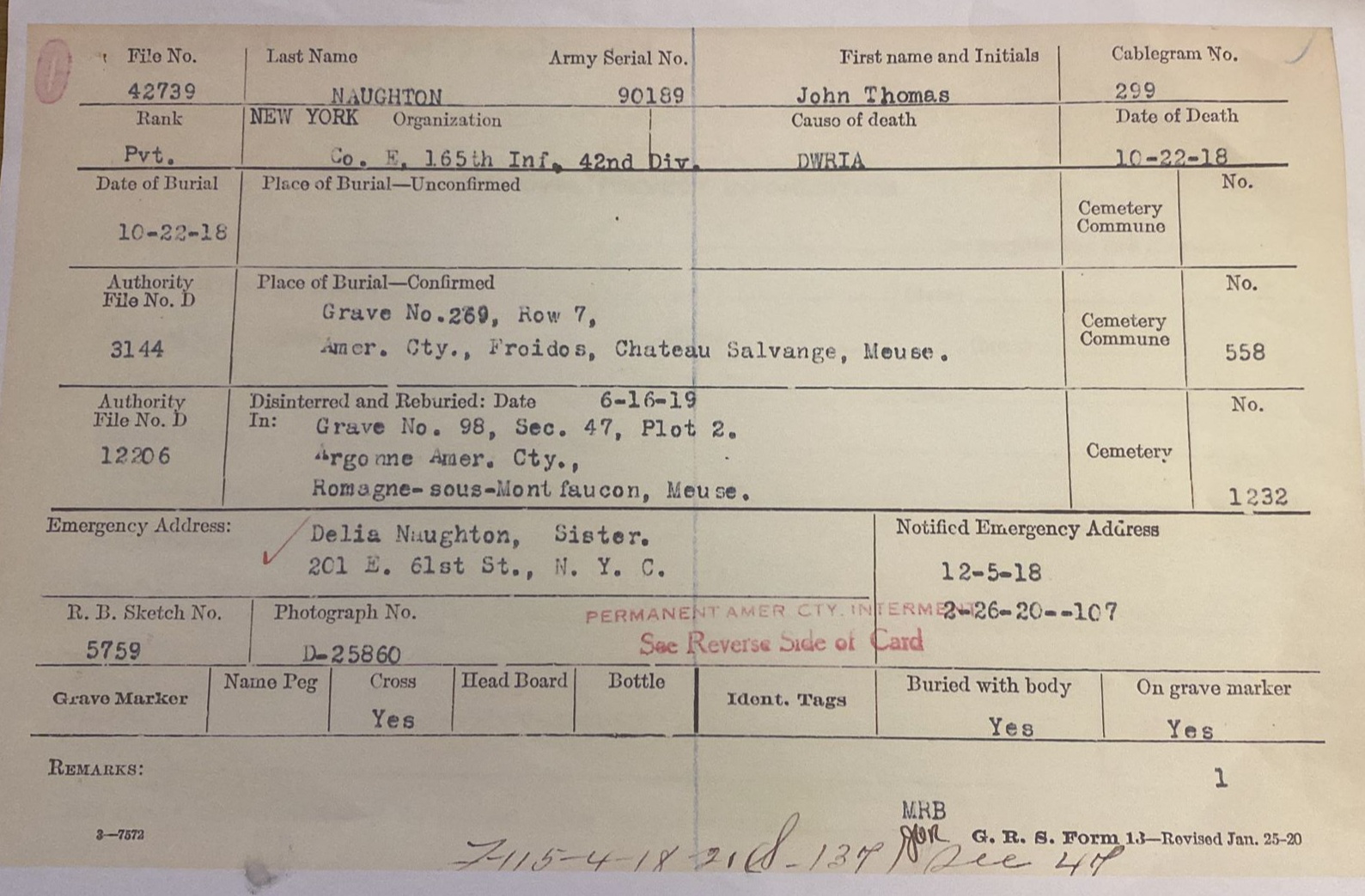
Removal Project Information Card (Front)
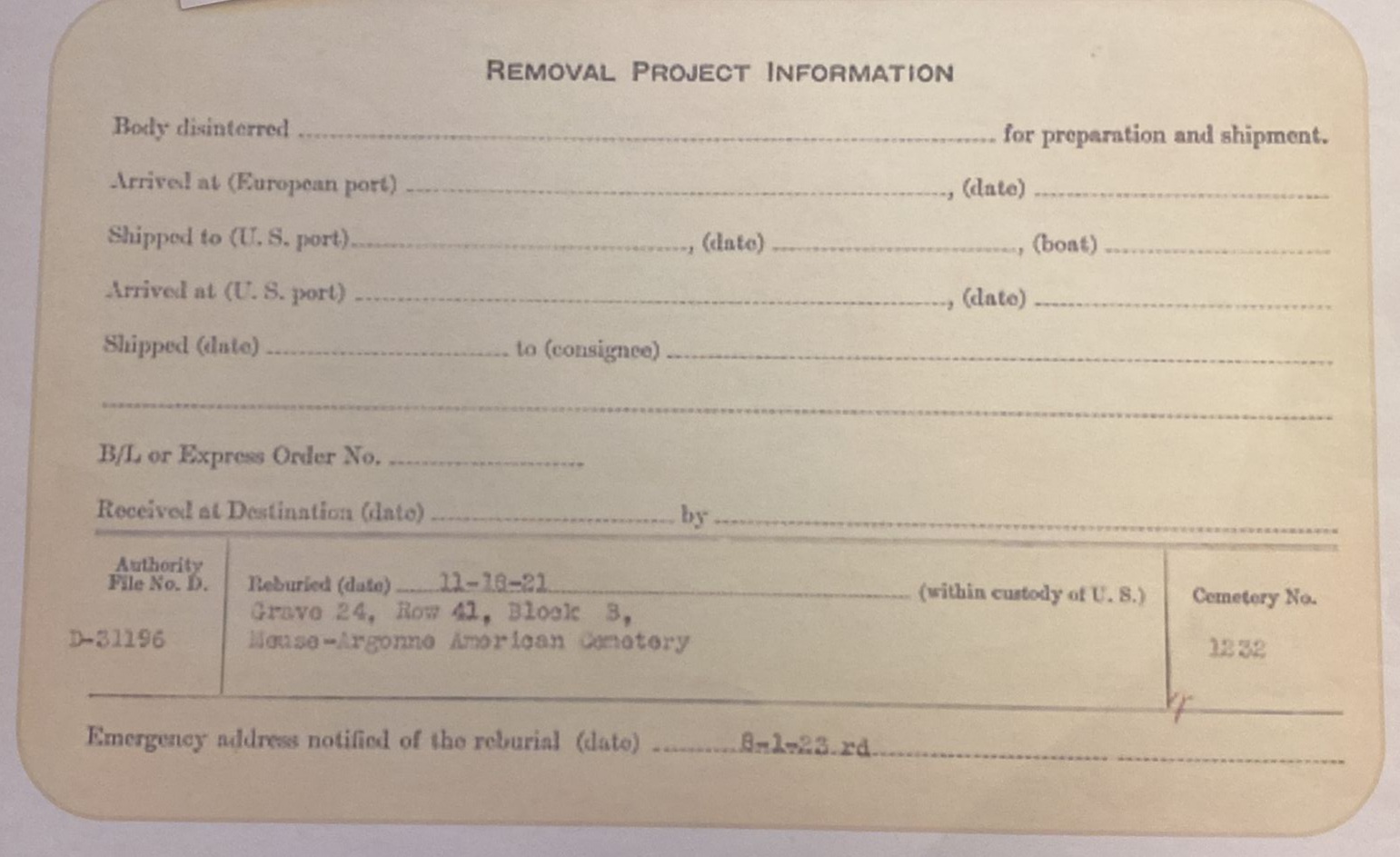
Removal Project Information Card (Back)
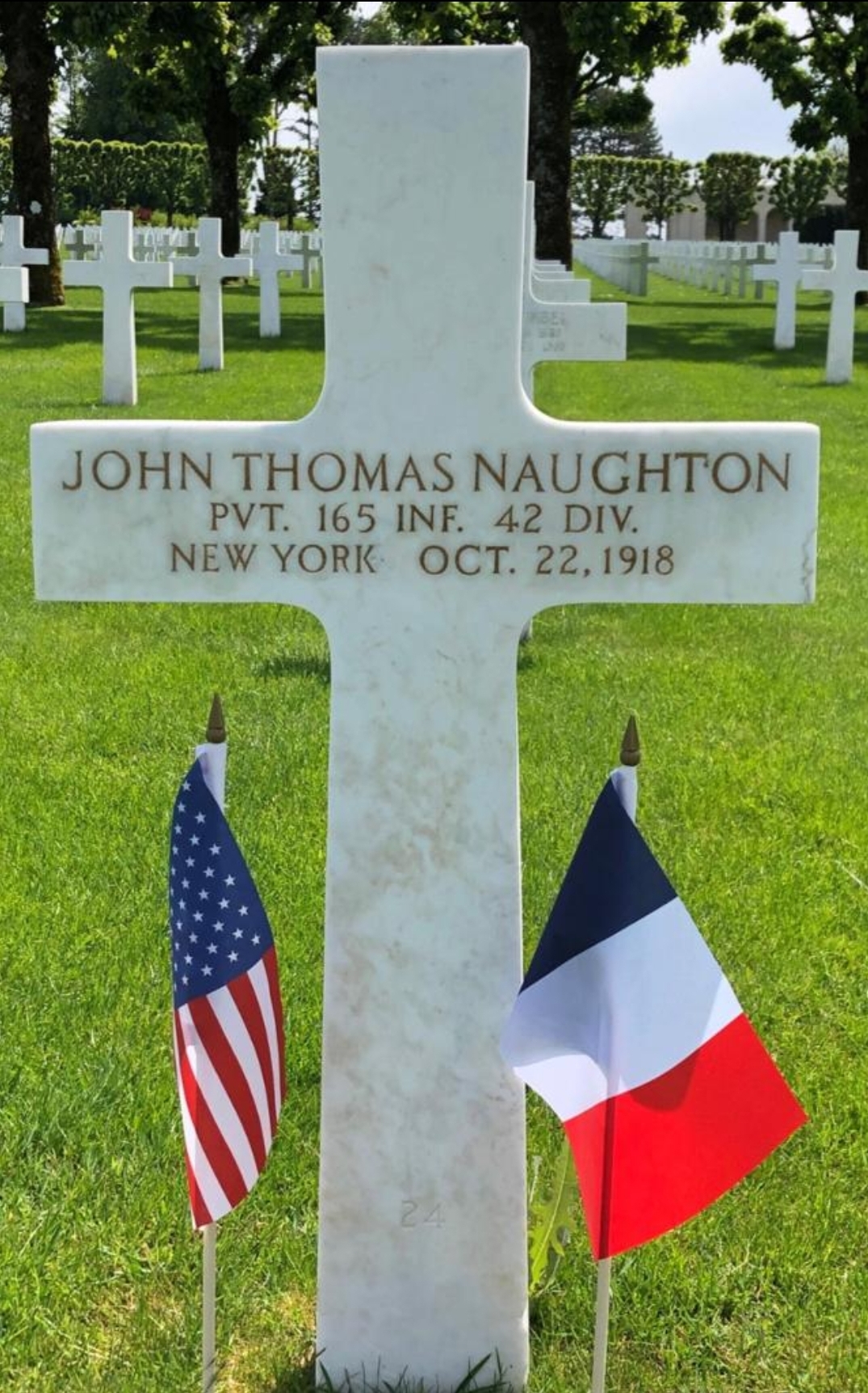
Final Resting Place of JN
In recognition of his service and sacrifice, Private John Thomas Naughton was awarded the Purple Heart, bestowed to those wounded (or killed) in action.
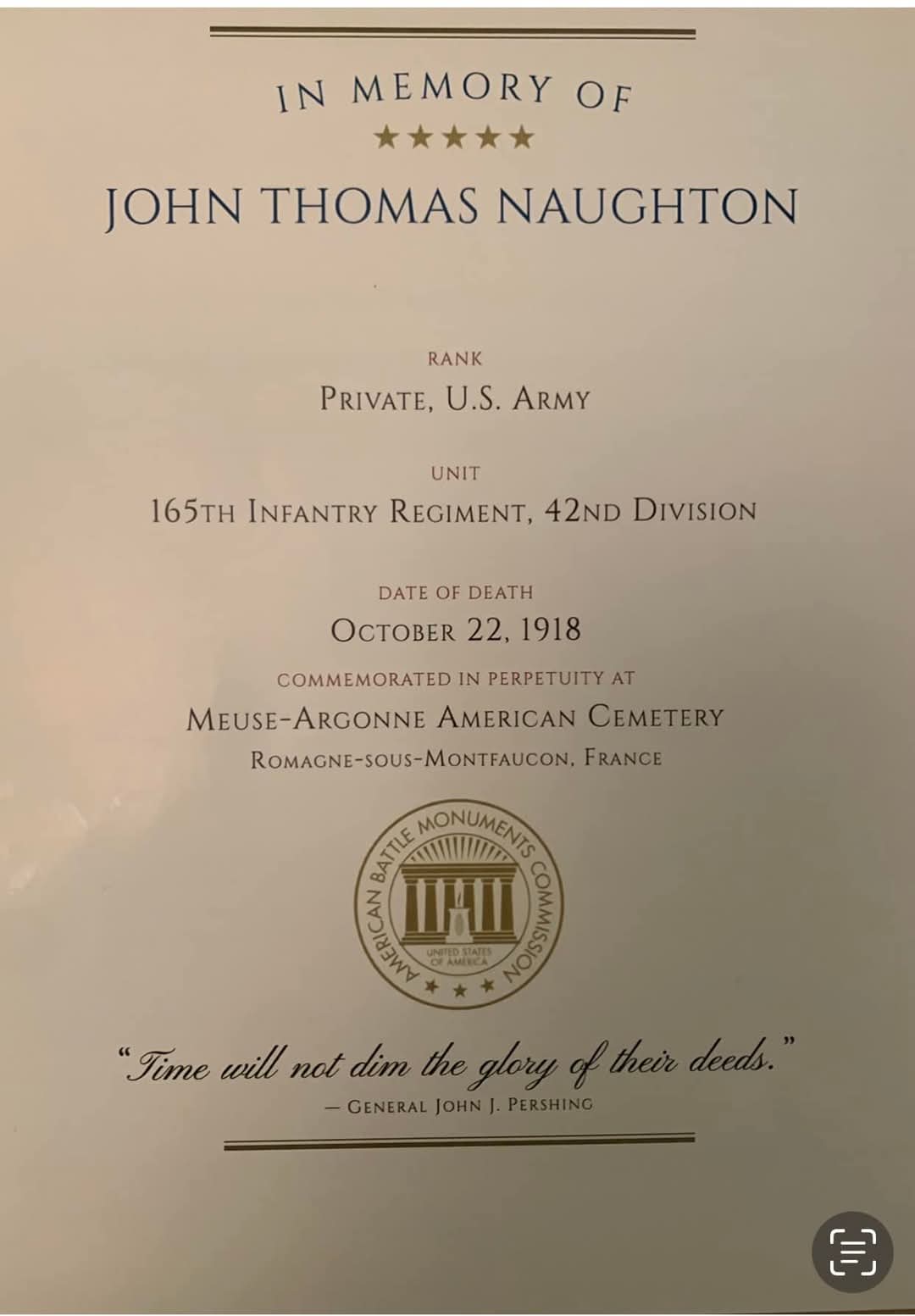
Army Memorial Document
Legacy
Pvt. John Thomas Naughton represents the many Irish immigrants who volunteered in the U.S. forces, fighting bravely far from home.
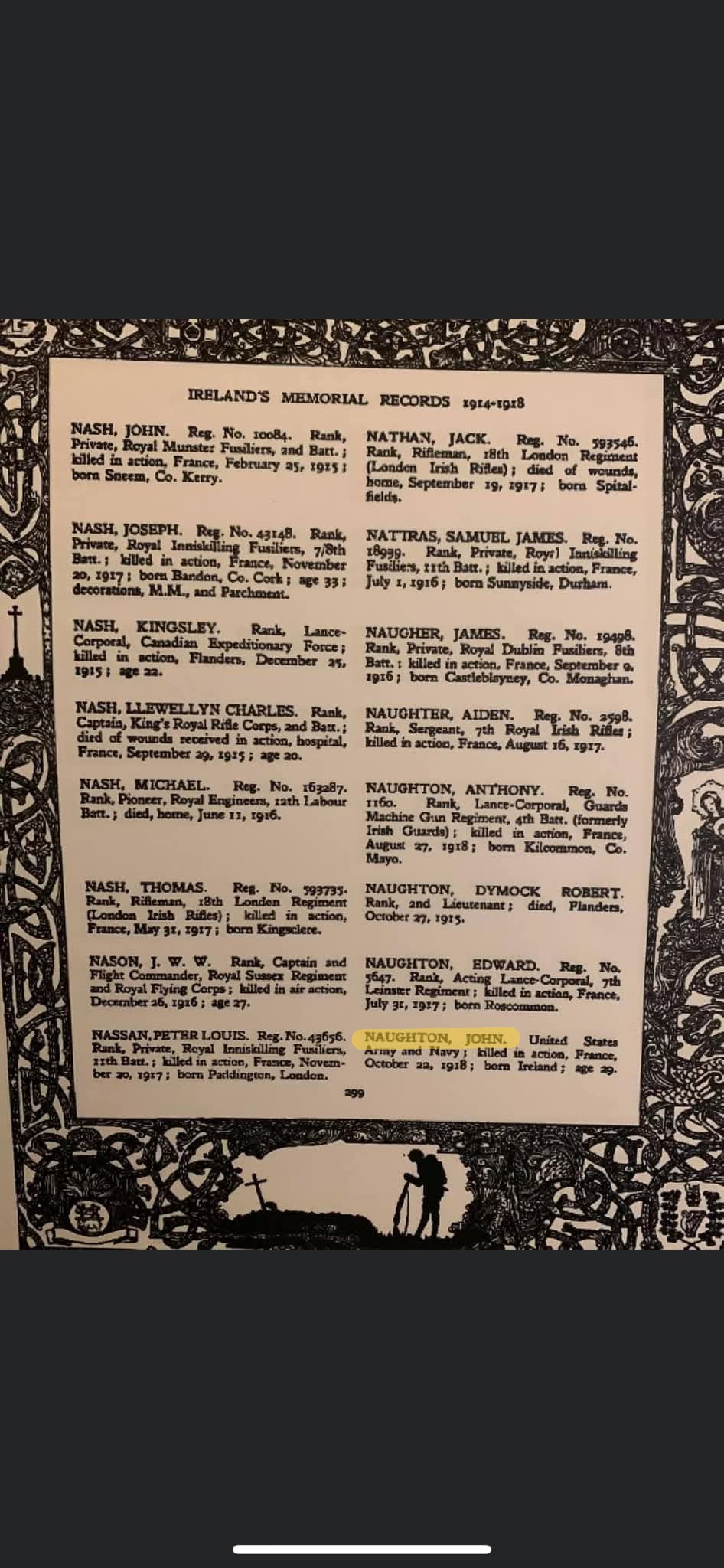
Irelands Memorial Records 1914 – 1918
His remains lie amidst 14,246 American war fatalities—exemplifying the sacrifice of the Rainbow Division’s men. Find a Grave. The Purple Heart medal honours him in perpetuity.
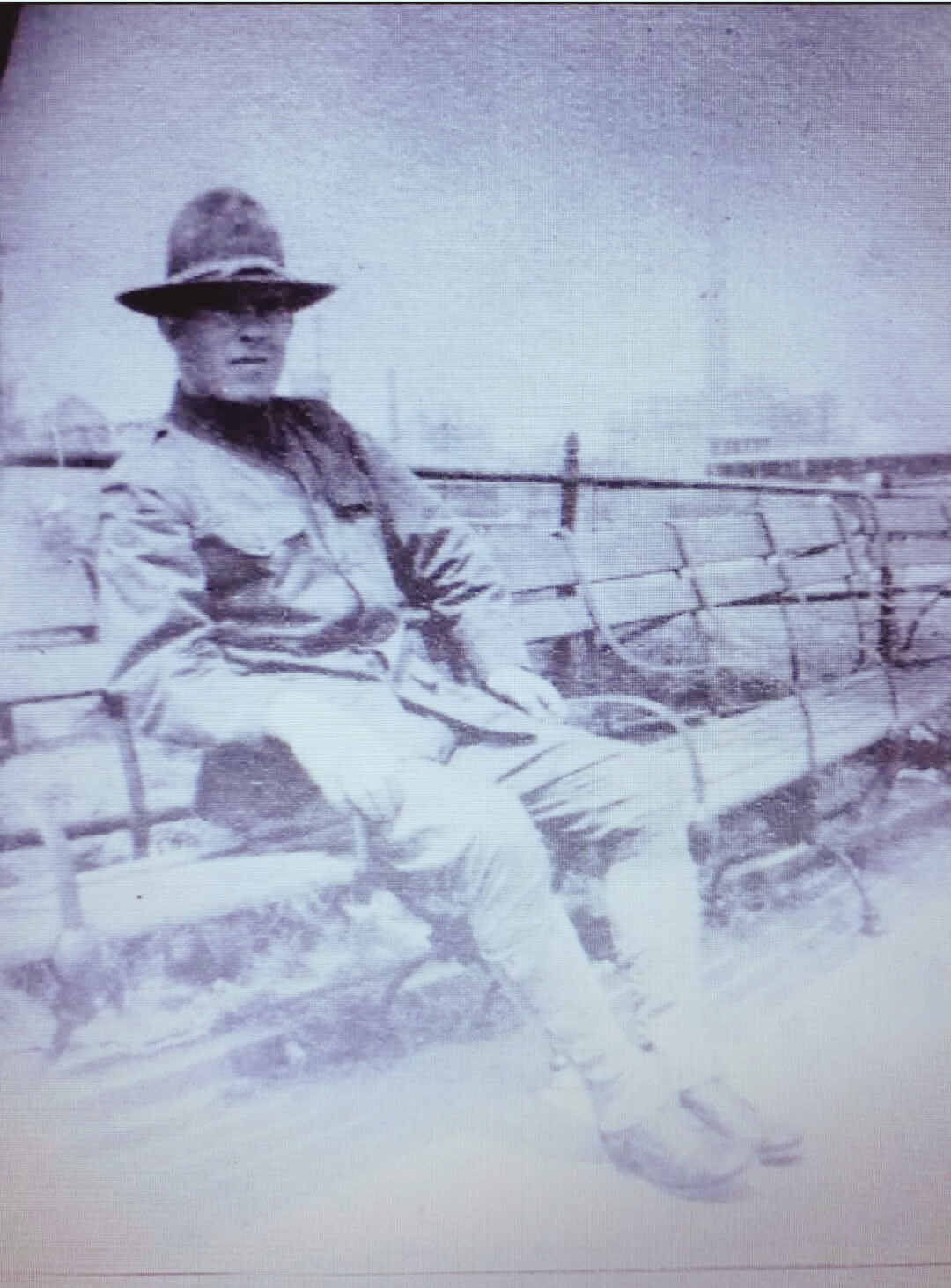
JN Sitting on bench in uniform – photo supplied by Vera – daughter of Michael Naughton
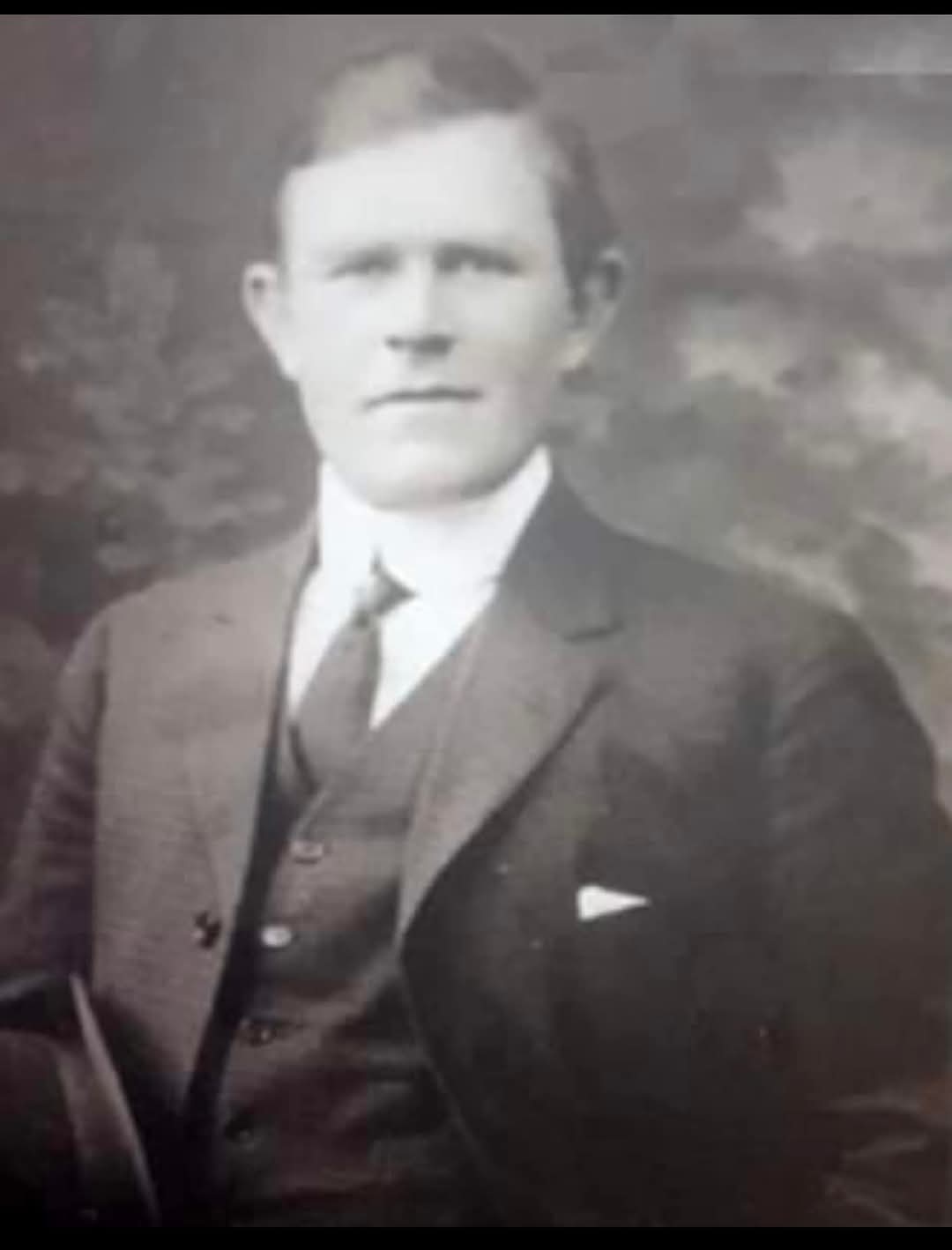
John Naughton – photo supplied by Vera – daughter of Michael Naughton
No Comments
Add a comment about this page